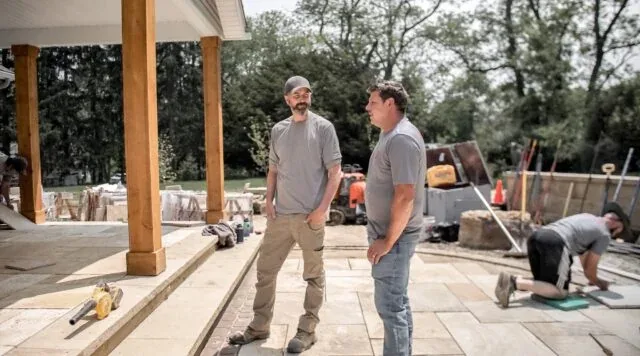

A picture-perfect landscaping consultation looks something like this: You show up to the property, walk the space with the homeowners, and ask all the right questions – what’s nonnegotiable, what’s flexible, how they plan to use the space once the job is done. By the time the consultation wraps up, you have everything you need to build a proposal. You send it before you pull out of the driveway. The clients, still excited about the job, sign immediately.
That ideal outcome depends on more than just what happens during the walk-through. The contractors who close consistently have built a sales process that starts before they even leave the office. One of the most important decisions in that process is whether or not to charge a landscaping consultation fee.
Consultation fees are a reliably divisive topic in the landscaping industry. At events and in contractor forums, experienced landscapers line up on both sides. Some have charged for consultations for years without a second thought. Others refuse on principle.
Let’s break down what that fee is actually doing, why some businesses swear by it, why others are better off without it, and how to filter effectively either way.
What Consultation Fees are Really For
The purpose of a landscaping consultation fee isn’t to recover the cost of gas, or even the cost of your time. The true value of landscaping consultation fees has nothing to do with money at all.
The real function of a consultation fee is to act as a filter for contractors who don’t want to waste time and resources (and yes, gas) on homeowners who aren’t serious about the job. A prospect who won’t commit $100 to have you come down isn’t one who’s likely to commit to paying tens of thousands of dollars to hire you.
The actual dollar amount you charge as a landscaping consultation fee doesn’t even matter that much. Whether you charge $5 or $500, what actually matters is that a transaction is taking place. That alone signals that this prospect is at least somewhat serious about moving forward.
Let’s use a pretty common scenario for contractors as an example. Imagine a couple with a big house and a bigger imagination, who spend a lot of time online. They come across some backyard photos on Instagram, and they decide that they want to build their dream backyard. They don’t know a ton about the industry, and don’t do any research. They decide that their budget for this project will be $40K. What they don’t know, and you will, is that all the time and work and materials it will take to build them a gorgeous backyard will run, conservatively, upwards of $100K.
Here is exactly where the amount of resources you spend on this couple splits into two paths. The first path is one where your business doesn’t charge landscaping consultation fees. That wide-eyed couple books you for a consultation about building that dream backyard. You make the drive, twenty minutes there and back (gas ain’t exactly cheap these days), see the property, talk to them, and realize they don’t understand the scope of the job. Once they do, they completely lose interest.
What if you take the second path, the one where you do charge a fee for consultations? Maybe that couple pulls up your website, and realizes that they’ll have to shell out $100 for you to come look at the property. This forces them to do a reality check about whether they actually want to do the work (and pay you what your time and labor is worth), or whether they just like the idea of the job.
If they balk at the fee, they might instead ask more questions over the phone or through your website. It’ll take about five minutes for them to find out that what they’re looking for is in the $100K-150K price range, and they’ll thank you for your time and hang up.
And you didn’t have to drive out to their property for them to reach that conclusion.
And that’s the real purpose of charging a consulting fee. To filter out window shoppers who were never actually going to buy from you. It’s about saving time, not money. You make money when you close jobs and collect deposit checks. Filtering protects your time so you can do just that.
Are Fees the Right Fit for Your Business?
Even contractors who do believe in charging a landscaping consultation fee might find themselves second-guessing the decision when pressure builds.
When the Fee Gets Tested
For example, maybe a contractor who has charged a $150 consultation fee for years without any pushback discovers a new competitor that offers free estimates. His lead volume starts to soften. Prospects start saying that they’ll just get quotes from companies that don’t charge for the consultation. That contractor starts asking, “Is my landscaping consultation fee filtering out bad leads, or filtering out all leads?”
A key detail here is that the competitor’s final quotes were pretty similar in price. The contractor who charges the fee isn’t being undercut or priced out. They just happen to be chasing the same jobs at similar rates, without the upfront barrier.
Many contractors might be tempted to fold here, but first, stop and ask yourself a simple question.
If you keep charging a consultation fee, will you still get enough consultations to fill your crew’s calendar?
For contractors with higher average job values who need a handful of projects to fill a season, the answer will almost always be yes. The volume of refusals may go up, but the leads who do pay are converting. The fee is working, even if it doesn’t feel like it is.
When to Question the Fee
Charging a landscaping consultation fee doesn’t make sense for every business. These two variables can help you decide whether or not it’s a good fit for you.
Job Size and Ticket Value
The filtering power of a landscaping consultation fee scales based on the size of the job itself. For a $50K design-build project, $150 is a rounding error to anyone with a real budget. But for a $500 lawn cleanup, a $75 consultation charge feels disproportionate, and might turn away perfectly good clients. If your core service is low-ticket work, charging a fee creates friction that doesn’t serve you or your business.
Market Density and Lead Volume
Filtering makes sense only if enough high-intent buyers exist in your market to filter from. A Lamborghini dealer can afford to turn away tire-kickers because there are enough serious buyers to sustain the business. A dealership in a market without any potential Lambo buyers has a different problem entirely, and no amount of screening will fix it. If your inbound lead volume is thin, turning away marginal prospects may truly cost more than it saves.
The Main Question
The best way to guage whether you should charge a landscaping consultation fee is by asking yourself one question. “Am I wasting too much time on leads that were never going to buy from me anyway?”
If the answer is yes, then how can you filter and vet those leads better?
Other Ways to Filter
There are more ways to successfully filter than just by charging for a landscaping consultation. Here are two other methods you can use alongside consultation fees – or alone, if you’re dead set against charging a fee.
Defined Availability
Instead of trying to build your schedule around when prospects are free, offer specific consultation windows and stick to them. For your company, maybe that looks like offering consultations on Tuesday and Thursday afternoons, with no appointments after 5PM. No exceptions.
Setting specific availability windows signals to the prospective client that your time has value. If they can’t plan around that, they’re probably not that serious about the job. A prospect who can’t accommodate a defined schedule, or pushes back on it, is telling you how they’ll behave as a client. The ones who respect your time and your process have already demonstrated a baseline level of commitment before the landscaping consultation even starts.

Project Planner
The project planner is one of the most powerful ways you can filter prospects. It works by solving one of the most painful (and prominent) pain points in a landscaping consultation: the prospect who has no idea what things actually cost.
A project planner is an interactive tool, usually hosted on the landscaper’s website, where prospective clients select what services they’re interested in, with photos, descriptions, and price ranges attached to each option. By the time they submit the planner, they’ve already been educated about what things cost. When the landscaping consultation does happen, it can start with everybody already on the same page.
The alternative to prospects finding out what a job costs via the planner is them finding out on-site. Using a project planner closes the gap between what clients think a job will cost and its actual cost, and it does so in a way that’s informative instead of awkward.
Using a project planner also filters passively. If a prospect refuses to spend ten minutes reviewing services and prices before booking their landscaping consultation, they’re probably not a serious buyer. In a well-built intake process, completing the planner should be a required step before the consultation gets confirmed. It functions as a filter even before you filter in whether money is changing hands.
If you need a reference for how a planner functions and what it should look like, check out the project planner used by Tussey Landscaping. It’s one of the best filtering tools in the business.
SynkedUP Helps Contractors Secure Jobs with Confidence
That signed contract at the end of a great landscaping consultation doesn’t happen by happy accident. It’s backed by a process that starts well before you pull into the driveway, and a huge part of that process is making sure that the right prospect for your business is standing there when you arrive.
Charging a landscaping consultation fee is the most direct way to build that process. It passively filters potential clients willing to commit to hiring you (and paying you well for your hard work) from ones who are just window shopping. Alongside (or instead of) consultation fees, defined availability and a project planner also help close that gap.
Business is a constant game of honing your processes, working to become more efficient, and getting a better return on your time and hard work. That exact pursuit is why we built SynkedUP, while figuring things out in the real world at our own landscaping business. We wanted to work smart, efficiently, and profitably. If that’s what you want too, well, check it out. Today it helps contractors all over North America be the best business in their market, save time, and make more money.
Schedule a demo with SynkedUP today to learn more about how our tools can build on your foundation to get your business exactly where you want it to be.


