
Finding and keeping good employees is hard, so it’s in your best interest (and theirs) to take good care of the landscape crew you already have.
You should want your landscape crew to find fulfillment and success in their roles. When they do, they work faster, work smarter, and have more reasons to stay with your company.
Today, I’ll break down three practical ways to take care of your landscape crew:
- Set them up for success on every job
- Give out results-based bonuses
- Praise their good work and seek out their input
1. Set Your Landscape Crew Up for Success on Every Job
Any of these scenarios sound familiar?
- A crew member has to drive back from a jobsite to the shop for a tool nobody thought to pack.
- The whole crew goes to the supplier to pick up materials one person could have collected alone.
- The team has to work without the right equipment, so the job takes longer.
These are all examples of what happens when you don’t give your landscape crew the information and the tools they need to do work efficiently.
If a crew leader (aka your landscape foreman) starts a job with incomplete details, they end up wasting time on unnecessary tasks (like extra trips to the shop or the store). That’s wasted time you’re paying for, and money that comes directly out of what should have been profit.
I ran a crew at Tussey Landscaping for about 10 years. During that time, the company grew from a little over $1M to $5M. In my experience, those extra trips and wasted time happened because the person who sold the job didn’t give the crew leader enough information.
For your landscape crew to succeed, you need to give them complete details about the job and the right equipment to finish the job on time.
Invest in your Crew
Your crew’s success is your success, and investing in your crew is investing in the future of your company.
So put your money where your mouth is, and show up for your crew. Replace broken equipment before it becomes an issue. Provide them with tools that make the work easier. Set clear expectations for what success looks like on every job.
You should also make sure that your landscape crew leader has these details for every project before it kicks off:
- The client’s name, address, and phone number
- The scope of work: a description of the job or a copy of the signed contract
- Materials lists with quantities, vendor orders, and the supplier for each material
- Photos of the site and the design
- Information on site access
- The closest dump site for debris and other waste
- Estimated man-hours for each work area
- A day one plan: what the client and salesperson want the finished product to look like, the tools and equipment needed on day one, and how many crew members to send
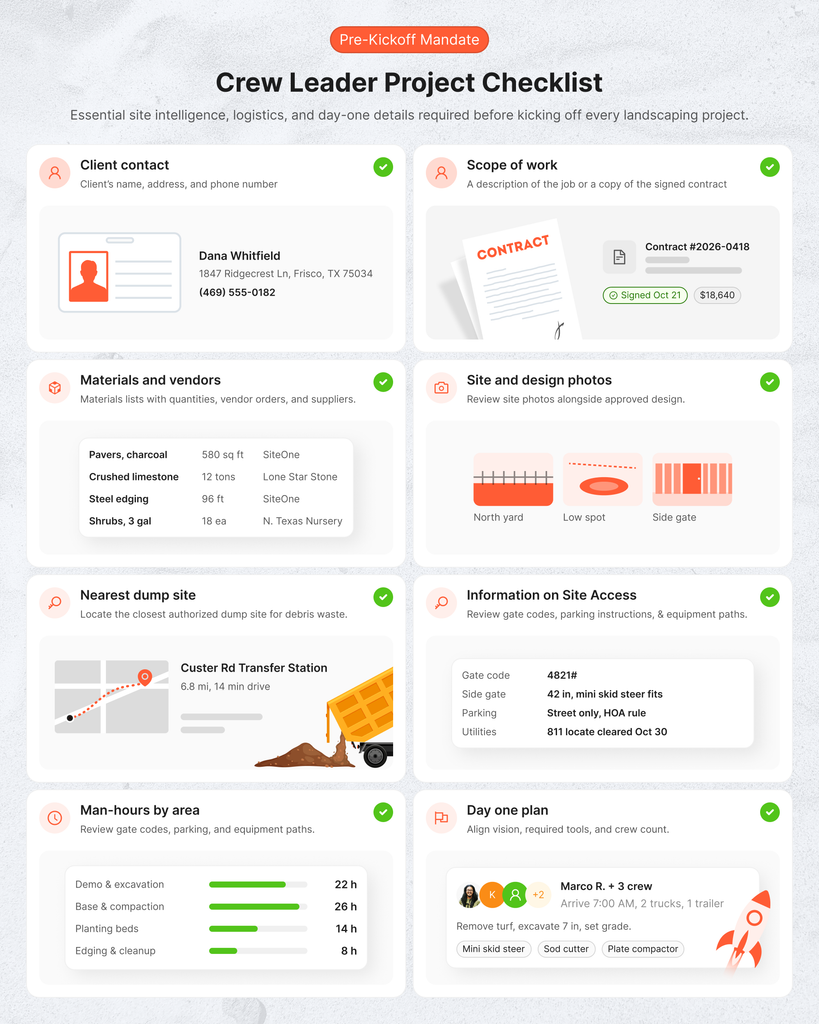
As a crew leader, I only needed that first day planned for me. After that, I planned crew size, equipment, and deliveries myself. I recommend you have your foreman do the same.
After day one, let your crew leader take responsibility for the outcome of the project. Do this consistently on every job.
Over time, that crew leader will take more and more pride in the work and eventually reach a place where they can solve site problems without involving you at all.
Choose a System for Information and Use It Consistently
When I started running a landscape crew at Tussey, we used a paper checklist in a job folder for every job we sold. (That checklist looked a lot like the list you see above.)
These days, I’d recommend using a digital folder on your phone that holds the same information and is (slightly) harder to leave behind or misplace.
Whatever format you use for your checklist, fill it out completely every single time. Foremen who know they’ll always find the information they need in the folder will check the folder first instead of calling you.
If that folder doesn’t consistently hold everything they need, they learn to call you first. And you stay the bottleneck, every time.
Hold Your Crew Accountable With a Written Record
The picture I’m painting of someone who takes responsibility if you give them clear details and expectations still requires a landscape crew member with a good work ethic. Unfortunately, not all humans possess (or even want) a solid work ethic.
But at least you know you’ve communicated instructions and expectations clearly. You’ve set your crew up for success; if they still fail to deliver, you have a concrete record you can use to hold them accountable.
So if a crew starts a job without the equipment the job required, you can say, “Why didn’t we have the proper equipment at the job site? Your instructions clearly stated that we needed that equipment to kick off the job. What happened?”
Either somebody made an honest mistake, and you can all brainstorm a way to keep it from happening again. OR it’ll expose a crew member’s poor performance, and they won’t be able to hide it or blame someone else.
2. Build an Incentive Plan For Your Crew
An incentive plan pays your landscape crew extra for results that save the company money. This gives them a reason to actually care about each job’s hours and costs, just like you do.
I’ve been there. I’ve been the “bad employee” who needed to be shown what success looks like. I’ve been on the receiving end of incentive plans. I’ve also talked to a lot of owners who’ve tried plans that did or didn’t work.
Let me share what I’ve learned:
Pay Bonuses for Results Your Crew Controls
First, an incentive plan for your landscape crew needs to be based on something measurable that your crew can impact or control within the scope of their roles and responsibilities.
Some teams use net profit , but it makes a poor measure to use for offering bonuses. Sure, your crew’s work affects net profit, but so do your landscaping prices, and you set the prices.
Man-hours make a better measurement. Your crew controls how long a job takes. When they finish under the hours estimated, your net profit increases.
To choose bonus measures, list what your crew needs to actually report: actual man-hours for each job, every receipt traced back to its job, and daily photos, notes, and progress updates. Use those as a basis for your bonuses.
Three Bonuses to Offer Your Crew
1. Accurate Time Tracking
You have to be able to assign every hour of payroll to a specific task or project to accurately calculate your job costs. For this to happen, every member of your crew has to log every hour they work, consistently and accurately. Otherwise, you won’t be able to tell where that time is actually going.
Incentivize your crew to take their time tracking seriously by paying a set amount (maybe around $50) for every week or month in which every timesheet came in accurate, on time, and without you having to ask.
2. Receipt Tracking
When a receipt goes missing or comes back without a specific job marked on it, it basically means you’ve spent money but can’t assign the purchase to the project that used it. Members of your landscape crew handle those receipts.
Pay a bonus for every period in which every receipt comes back properly labeled. If any go missing or come back unmarked…well, there goes the bonus for that period!
3. Beating Estimated Hours
Pay out a bonus to your landscape crew when they complete a job under the hours estimated (without any quality problems). Now, they can only earn that bonus if your estimates are realistic.
Maybe on a particularly busy day you rush an estimate and lowball the number of hours the job will take the crew to finish. Your landscape crew foreman might look at the estimate on day one and know that the crew can’t finish it in that amount of time.
In cases like that, the bonus will discourage your team way more than it motivates them because they’ll feel like you’ve set them up for failure. Which you basically have.
On accurately estimated jobs, the bonus gives your crew a financial reason to save hours. They pay closer attention to late material deliveries, delivery and pickup plans that waste time, and when they don’t have the right equipment on site.
No matter how talented the crew or accurate the estimate, sometimes jobs will run over. When they do, don’t get upset. Ask the crew why it went over.
How they respond will let you know whether to raise your estimates for similar work or fix a production problem, like poor scheduling.
Or you might find that you need to improve your estimating. To start, I suggest checking out SynkedUP’s free production rate calculator. Take a few minutes to input your actual job data, and the calculator will find your company’s production rates for tasks like installing mulch or mowing lawns.
The more jobs you log, the more accurate your rates will get over time, and so will your estimates. Check it out here!
Keep it Simple and Pay on Time
Every member of your landscape crew should understand how bonuses work. Keep the plan simple, the dollar amounts flat, and your crew in the loop.
Make sure they understand the connection between the bonus and the behavior it rewards. The reward will have zero impact on your team’s work if they have no idea why they got a bonus check for a certain amount.
Pay every bonus on the date you promise. Don’t ever forget or delay a payout. The sooner after the work your crew receives the bonus, the more they connect their performance to extra money. That connection will change how they work.
3. Recognize Your Crew’s Work and Ask for Their Ideas
Your landscape crew needs to hear that you notice their hard work. Praise what they do well, get their input and ideas before you make decisions, and expect them to bring possible solutions to you along with their problems.
Praise Good Work in Front of the Team
Everyone makes mistakes, and you will need to address them when they happen. Make sure that your crew also hears from you when they do something well, like:
- A landscape crew leader reordering pavers before the crew can run out
- A crew member cleans the client’s driveway at the end of the day without anyone asking
- A crew member catches a measurement error in the design before installation
Name the specific action when you praise someone. “Thanks for catching that drainage problem before we laid the patio!” tells a crew member exactly what you value, and that you’re paying attention.
“Good job today” is nice, but it’s vague. What does “doing a good job” look like? Keep calling out and praising the behavior you want to see, and you’ll see more and more of it.
Hand out praise when the whole crew is together, like at the start of the day or when you’re all on site. Save criticism of individual landscape crew members for a one-on-one conversation at the shop or in the truck.
After your crew does especially great work, thank them with something they can look forward to. When I was a crew leader, Tussey held a company lake day every August, during the hottest part of the year.
Plan something similar for your own landscape crew. Maybe that looks like a lake day for your own company, or a cookout, or a ball game. Schedule it during your hardest stretch of work.
Ask for Input and Let the Crew Solve Problems
Before you just tell your crew what to do, ask for their input. If you realize that staging materials is going to be tough on a tight site, you don’t have to immediately answer the problem with your own solution.
You also have the option of turning to your crew lead and saying, “Any ideas?” They might say no…or they might think of something that never would have occurred to you.
Encourage independent problem-solving in your landscape crew by giving crew as much freedom to make decisions as you can. For example, if trucks keep returning to the shop for forgotten equipment, tell your team what those extra trips cost the company.
Then add, “Any ideas for preventing this going forward?”
As an owner, you spend a lot of time putting out fires, but you shouldn’t think of yourself as the only person capable of making decisions and finding solutions. That’s not sustainable. Plus, it puts a limit on what your team can achieve when you’re not around.
Don’t just give your crew orders. Running jobs that way creates a cycle that you have to repeat all day: you tell the crew what to do, check their work, and assign the next task.
Then you get stuck in the cycle. Your crew learns to rely on you every time they have a question or an issue. Congratulations! Now you’ve created a company that can only complete as many tasks as you can personally assign and check in a day.
Why restrict your growth like that?
Use the 1-3-1 Rule for Complaints
When a member of your crew comes to you with a complaint or a problem, what do you do? Do you immediately give them a solution?
Don’t do that.
Instead, make the 1-3-1 rule a standard practice with your crew. Every complaint should come with one problem, three possible solutions, and one recommended solution.
Let’s say a crew member gets frustrated with an unreliable steer skid. They should bring it to you like this:
- Problem: The skid steer broke down twice just this month, and the crew lost time waiting on repairs.
- Three solutions: Repair it again, rent a skid steer for the rest of the season, or buy a replacement.
- One recommendation: Rent one for the rest of the season, and replace the old skid steer over the winter.
Don’t act on a complaint unless your landscape crew member brings all three parts. This teaches your newest crew members who have likely never learned how to do this, to look for solutions before they bring you a problem.
It builds trust between you and your crew. It helps them develop into better workers, leaders, and problem-solvers. It also means you no longer have to come up with every solution yourself.
Equip, Reward, and Listen to Your Landscape Crew
Your landscape crew are a vital part of your business. So treat them that way:
- Always give them what they need to succeed in a job
- Recognize and reward them for positive results
- Get their input in solving problems
We built SynkedUP, our all-in-one landscape scheduling and estimating software, to make all of this easier. With our mobile app, landscape crew leaders can access materials lists, photos, notes, client info, and anything else they need right on their phones, even out in the field.
If a customer calls your office and asks for a change or delay in the job, your admin can address it directly in the SynkedUP app. Your landscape crew foreman will see the change immediately. Your team will learn to check the app when they have a question, instead of calling you.
With real-time tracking and job costing, your crew can see their actual hours against estimated hours as they work. That way, they can check every day whether they’re earning the estimated-hours bonus.
If they start to fall behind the estimate, they’ll catch it immediately. That way you can make any fixes or adjustments while the job is still running…..instead of catching the problem after the fact, when you’ve already lost money.
To learn more about how SynkedUP works and how our system can help your business, book a call today!


